|
Guided Fly Fishing in West Georgia FLINT RIVER SHOAL BASS - CHATTAHOOCHEE STRIPERS
LARGEMOUTH BASS & BREAM LAKES - GAR & CARP
|
|
Home Fishing Reports Locations & Species Tackle & Tactics Fly Box Guided Trips More |
|
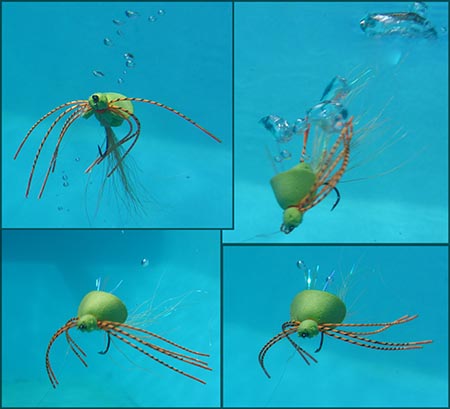
is a foam diver/slider that wiggles and dives on the retrieve. It casts easily without the twisting of lipped flies but dives enticingly on the strip. The rear tab of foam and the air space below it captures air which bubbles on the dive. The turbulence it creates, along with the dynamics of the wing, cause the fly to move from side-to-side. And because it sits a little lower in the water than the traditional bass popper, the hook-up ratio is quite good. The Stealth is similar in action and design to the Dahlberg Diver, which Lefty says is maybe "the most versatile and useful bass fly". The Stealth, with its foam construction, is easier to tie and doesn't get water-logged like the deer hair in the Dahlberg.
I think Jack Ellis, author of
Bassin' with a Fly Rod
|
|
"I've caught so many fish on it, I can't bear to take it off ". - Jack Dennis while filming an episode of "FlyFish TV" |
|
"... a certain graceful complexity that held my gaze when I was first sent the photos..". "...so different from what I’ve fished for years, but still oddly familiar – sort of reminding me of a Dahlberg Diver crossbred with a Gartside Gurgler..." "...But the action on the Stealth Bomber is different – it dives and makes noise like the Dahlberg, but it is more exaggerated. The dive is deeper with a shorter strip, and the pop it makes as it is pulled under the water is loud… It lands softly and can look unbelievably enticing as it sit motionless… Give the fly a subtle twitch from time to time with an occasional big jerk to plunge the Bomber deep under the surface, bubbles trailing the fly, then let it float back to the surface as gentle and pretty as you please..." The Best Bass Flies by Jay Zimmerman, 2017
|
|
".The Stealth Bomber is a blatant attractor pattern; it resembles nothing, and at the same time everything. Dobsonflies, moths, large caddis, stoneflies. You name it, the Stealth Bomber can vaguely imitate it. Consequently, the pattern has become darn-near ubiquitous among shoal bass fisherman. In some cases, you'll see entire boxes stocked with nothing but Stealth Bombers in various colors." - Zach Matthews , American Angler, May/June 2010 |
|
Fishing The Stealth The Stealth can be fished in numerous ways - dead-drifted in current, in still water with dead stops and slight twitches , chugged hard with stops in between, or stripped continuously where it will continue to dive. Try it with a dropper (I like the RLD) and the extra weight will let it dive pretty deep. A sink-tip or full-sinking line also work.
Second, don't set the hook by lifting the rod tip, but rather with a strip strike. Two reasons for this. If the fish doesn't have a good hold on the fly, you'll wind up pulling the fly out of the target zone (perhaps into your ear). If he does have the fly, the soft tip of a fly rod often will not have the power to set the hook.`Much better set with a strip strike - if he has the fly you'll hook up. If he didn't have it, the strip will move the fly about 12' totally convincing him it's real and alive and he'll likely jump it again. Set with the rod tip and the only fish you'll stick are the ones that hooked themselves before you moved the rod at all. Third is, whenever possible, fish with your rod tip on are near the water and pointed at the fly. This will put you in a much better position to strip strike. In addition to better hook sets, this will enable you to make the fly dive hard with a very short strip since there is no slack in the line.
|
|
"......We came out of the river and turned north toward Cedar Key. I fished the Stealth Shrimp, again it was very productive. Three slot reds and the specs wouldn't stop. They destroyed the foam, but I kept casting. Please Help!! I didn't see them online for sale, if they are even for sale...." - Earthworx, LRO Bulletin Board |
|
My original Stealth Bomber was tied with black foam and only a basic tail, the fly resembled theB-2 Stealth bomber and its delta wing. That's where the name comes from as I started tying it around the time of the first Gulf War. Here are the tying directions for the original version of the Stealth Bomber.
The foam shape has evolved over the years to improve balance and action. The final version is shown in the photo at right. The wide over-wing section is now more rounded and creates a better balance and improves the action.
The tying directions from the American Angler magazine are available here in a scaled, printable pdf for the "new & improved" version of the fly. Byron Begley from Little River Outfitters ties a slightly different version of the Stealth Bomber on the Little River Journal.
Tying Tips
|
|
"I had never heard of the Stealth Bomber... I pulled one out of the box ...On the first cast a bass slammed the fly. I caught eight bass in a row. The Stealth Bomber floats but when you strip it the fly dives under the surface and wiggles it’s way back to you...when I was stripping several bass were trying to grab the fly. I was amazed..." - Byron Begley, Little River Outfitters Journal |
|
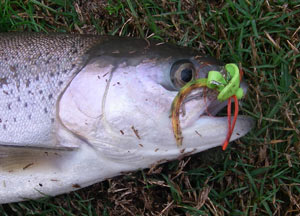
Way back in the 90's, I got an email and a photo (at left) from Gene M. in Iowa about the Stealth - "... the subject of bass flies came up. When it got around to the Stealth Bomber I said I was a real fan and had taken my personal best bass on one. Steve gave me the link to your site and suggested I drop you a note........I built my first one from a description given by a buddy who had seen one on TV. I came pretty close for never having seen one and it's fast become a favorite........ Remembering that Iowa is in "The Black Hole" of bass fishing and a five pounder is a good fish, here's a couple pics........The fish taken with the black bomber was 23 1/2" X 17 1/2"........Thanks for sharing a great fly."
Byron Begley on The Little River Outfitters Fishing Report, 11/4/08 There has probably been more written about that fly on our Message Board than any other. The reason is, it works and it works very well. My plan this winter is to tie Stealth Bombers in all sizes and colors to get ready for Spring bass fishing.
"Buster Wants to Fish" blog.... ."...Been tying up a (edit)load of Stealth Bombers. It’s been my go to topwater for bass for the past year. It’s cheap, skates like Kerrigan (pre-Tonya), and comes in whatever color and style you create. Works great with a dropper. I like ‘em in size 6 or 8. White is my favorite color this time of year. Many thanks to Kent Edmonds for the creation of this little gem...."
An email from Byron at Little River Outfitters "Jack and I went fishing on the lake all day yesterday. I hurt my back the day before and didn't fish much. At first the smallmouth bass were following our wooly buggers and not taking them. We caught a couple. Jack finally said he was going to try a stealth bomber. He caught 3 smallmouth in four casts. We would cast them out and twitch a couple of times. Then we would watch as big smallmouth would rise and sip them off the surface. Sometimes we would see cruising smallmouth in clear water. We would cast in front of them and they would come up and sip the fly sometimes. Jack caught one that we think would have weighed 5 pounds but she had shed her eggs and weighed less. We both saw one take his fly that looked to be around 7 pounds. We caught some in the 3 pound class. I spent most of the day sitting in the back, drinking beer, resting my back and trolling Jack around the lake. We fished for 11 hours. I caught 12. Jack caught around 60. It was one of the best days of fishing in my life. I still can't believe it. We were at the right place at the right time and Jack knew to try the Stealth Bomber. ...Thanks Kent.
Hatches Magazine, Jeff Greendyk - ".......Another great fly is called the Stealth Bomber; it is a foam fly that is tied slider style. I use this fly for all species of fish that can be found in the Richmond area, catching everything from 3-4 in. long Bluegill in the office park ponds to 4+ lb. Smallmouth in the riffles....."
Warmouth3 on The Bass Pond Bulletin Board "..... I'm a real Stealth Bomber fan. I tied? - folded? one (get this) from a *description* a buddy of mine gave me that he'd seen on television. Caught an 8 pound (pb) bass on it. Sold me....."
|
|
Fly Fishing Georgia by David Cannon features a section on Georgia's Flint River and the shoal bass, one of the fisheries that gave birth to the Stealth Bomber. The book also highlights other Georgia fisheries, including trout and saltwater species.
|
|
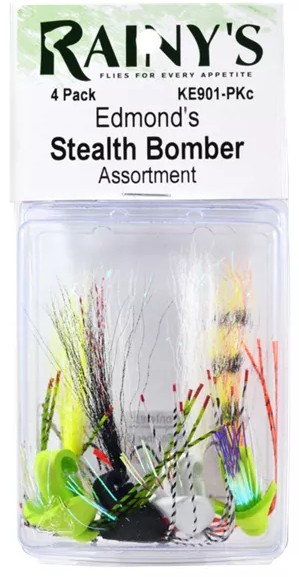
If you don't tie (or even if you do), the Stealth Bomber is available through Rainy Flies. They are available individually, and in 4-packs. Ask for them at your local fly shop or contact one of these: Fish Hawk - Atlanta, GA Unicoi Outfitters - Helen, GA Deep South Outfitters - Birmingham, AL Little River Outfitters, Townsend, TN
|
|
The "other Stealth Bomber"...
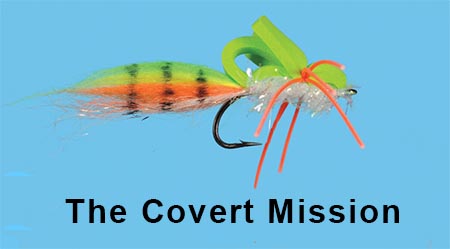
I also license a simpler, more basic version of the Stealth Bomber to Solitude Flies, which they tie and market under the name of the Covert Mission. The Covert Mission is tied with a simpler foam shape, basic legs, a synthetic tail, and a crystal chenille body rather than a hand-dubbed body. For these reasons, it is a less expensive tie. In spite of this, the fly still has much of the action and attraction of the original, and in many cases it works just fine. It is available at many of the same shops that carry the Original Stealth.
*There are a number of knock-off versions being sold online, but I do not recommend any of them. Typically they lack the proper proportions, and do not have the same action as the original. Many use inferior hooks and are not durable ties. Rainy's Stealth Bomber typically retails around $6 and Solitude's Covert Mission version at about $3. You might save a buck with the knock-offs - they may still work sometimes, but not nearly as well. Buy the real thing, or call me and I'll tie some just for you.
|
|
C o n t a c t
K e n t at
kent@flyfishga.com
or 7 0 6 - 8 8 1 - 3 2 4 9. |
 The
Stealth Bomber
The
Stealth Bomber  ,
coined the term "fence-rider" to describe a fly that was big enough to attract
big bass, but small enough to catch big bream (sunfish) too. Back in the 90's, a
pal got me started fishing Turck's Tarantula for bass and bream. It worked great
as a "fence-rider" - catching bass and bream. The Tarantula was designed as a trout fly and won the Jackson
Hole One-Fly contest a few years back, but I like it for bass and bream. The
Stealth takes a lot of its inspiration from the Tarantula too. I tie it with a
#6 Gamakatsu B10S hook.
,
coined the term "fence-rider" to describe a fly that was big enough to attract
big bass, but small enough to catch big bream (sunfish) too. Back in the 90's, a
pal got me started fishing Turck's Tarantula for bass and bream. It worked great
as a "fence-rider" - catching bass and bream. The Tarantula was designed as a trout fly and won the Jackson
Hole One-Fly contest a few years back, but I like it for bass and bream. The
Stealth takes a lot of its inspiration from the Tarantula too. I tie it with a
#6 Gamakatsu B10S hook.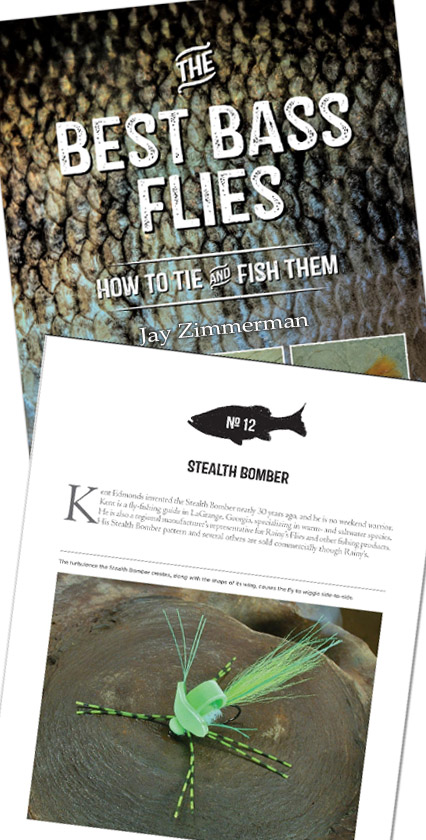
 Three things are very
important. Use a fairly heavy tippet (I like 1x
or 0x on #6 Stealth) or the
tippet will twist when casting.
Three things are very
important. Use a fairly heavy tippet (I like 1x
or 0x on #6 Stealth) or the
tippet will twist when casting.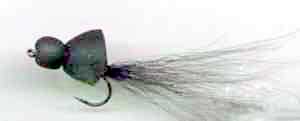 Tying The Stealth Bomber
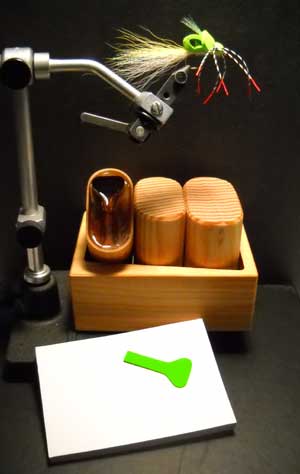 These days, I often tie some in bright color
combinations
and add flash wings and rubber legs.
A friend named this version the "Full Pimp". The "stealth" name
hardly applies to its appearance, but its action can still be quite
stealthy if you drift it or work it with soft twitches.
These days, I often tie some in bright color
combinations
and add flash wings and rubber legs.
A friend named this version the "Full Pimp". The "stealth" name
hardly applies to its appearance, but its action can still be quite
stealthy if you drift it or work it with soft twitches. 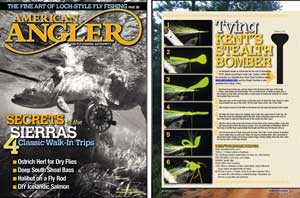
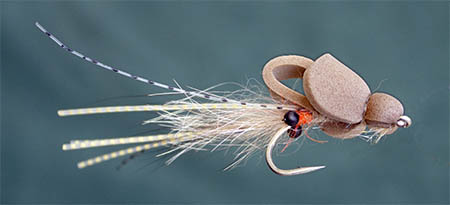 Byron
also showed me a "shrimp version" of the Stealth he started tying. I
liked it and copied his idea (see photo on left). I tie the shrimp
Stealth on a Gamakatsu SC15 in 1/0 and 2/0 hooks. And I've started using
the Gamakatsu SL12S in a #1, especially in the tarpon and snook
versions. The tail (which in this case is actually the head) is a mix of
hair and sometimes synthetics, including coyote body hair (thanks
Byron
also showed me a "shrimp version" of the Stealth he started tying. I
liked it and copied his idea (see photo on left). I tie the shrimp
Stealth on a Gamakatsu SC15 in 1/0 and 2/0 hooks. And I've started using
the Gamakatsu SL12S in a #1, especially in the tarpon and snook
versions. The tail (which in this case is actually the head) is a mix of
hair and sometimes synthetics, including coyote body hair (thanks
 Angler Feedback on the
Stealth
Angler Feedback on the
Stealth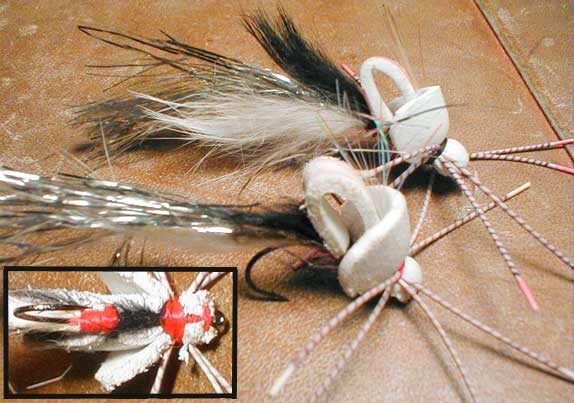 Here's some visual feedback from
the shoal bass over on the Flint River....the inset
and the fly in the foreground evidence the response of the shoalies to
this "FP" version of the Stealth. The fly at the top of the photo
is how the lower fly started off - smooth foam and a double zonker strip
for the tail. After a day with the shoal bass (and some red-breasts
too), the foam is ragged and the rabbit zonker stripped almost to the
hide. This may be the new version though, as the fish were still eating
the pitiful little thing when we quit. ;)
Here's some visual feedback from
the shoal bass over on the Flint River....the inset
and the fly in the foreground evidence the response of the shoalies to
this "FP" version of the Stealth. The fly at the top of the photo
is how the lower fly started off - smooth foam and a double zonker strip
for the tail. After a day with the shoal bass (and some red-breasts
too), the foam is ragged and the rabbit zonker stripped almost to the
hide. This may be the new version though, as the fish were still eating
the pitiful little thing when we quit. ;)


 Where
To Buy The Stealth
Where
To Buy The Stealth